




Starting a business in Massachusetts is exciting, but the legal steps can feel confusing if you have never done it before.
One of the most popular business structures entrepreneurs choose is a Limited Liability Company, commonly called an LLC.
An LLC is widely used by freelancers, consultants, small local businesses, ecommerce sellers, and startups. The reason is simple.
It provides liability protection while keeping the business structure flexible and relatively easy to manage.
Massachusetts does have higher filing fees than many other states, but the formation process itself is straightforward.
Once you understand the steps, most entrepreneurs can complete the process without major difficulty.
This guide explains exactly how to create an LLC in Massachusetts, the costs involved, and what responsibilities you will have after your business is formed.
What Is an LLC?
A Limited Liability Company is a business structure that separates your personal finances from your business finances.
This separation is important because it protects your personal assets if the business faces legal or financial problems.
For example, if your business cannot pay its debts or becomes involved in a lawsuit, your personal savings, home, and other personal assets are usually protected.
LLCs are popular because they combine several advantages.
Key benefits of an LLC
- Personal liability protection for the owners
- Flexible tax treatment
- Fewer formal requirements than corporations
- Easier management structure
- Greater credibility with customers and partners
Another major advantage is taxation. By default, LLC profits pass directly to the owners and are reported on their personal tax returns. This avoids the double taxation that traditional corporations often face.
Because of these benefits, the LLC has become one of the most common business structures in the United States.
Steps to Form an LLC in Massachusetts
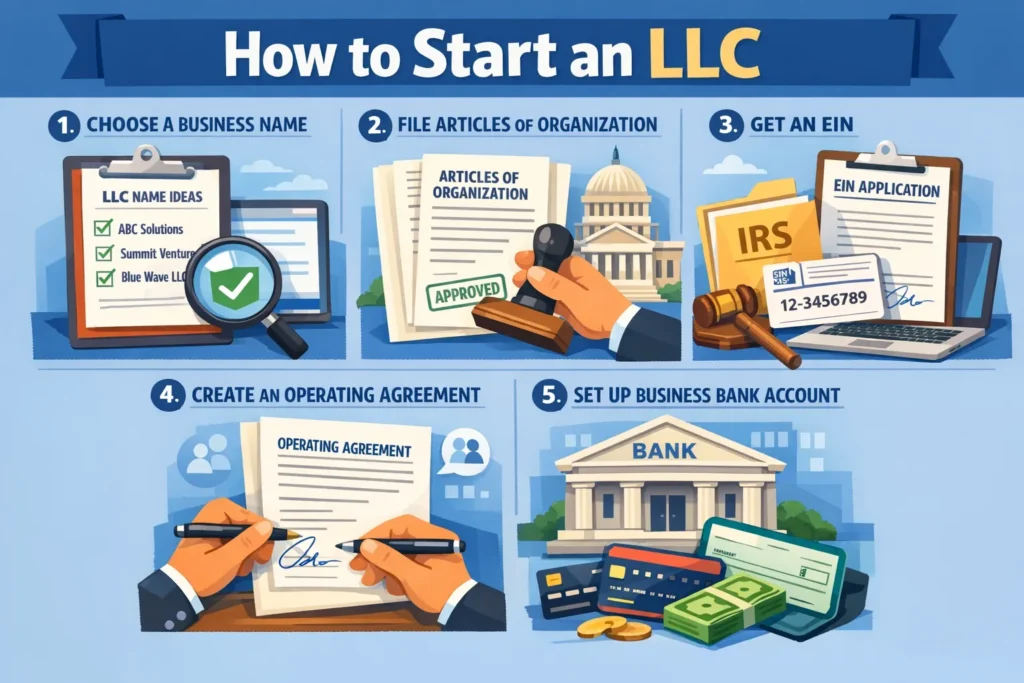
Creating an LLC in Massachusetts involves a few important steps. Some entrepreneurs complete the process themselves, while others use LLC formation services to help with paperwork and compliance.
Either way, the legal process follows the same structure.
1. Search Your LLC Name
The first step is choosing a name for your business.
Massachusetts requires every LLC name to be unique and distinguishable from existing businesses registered in the state.
Your LLC name must also include one of the following words or abbreviations:
- Limited Liability Company
- LLC
- L.L.C.
Examples of valid LLC names
- Boston Creative Marketing LLC
- Harbor Consulting Group LLC
- Bay State Digital Solutions LLC
Before finalizing the name, you should check the Massachusetts business name database to confirm it is available.
Tips for choosing a strong business name
- Keep the name short and easy to remember
- Avoid names that are too similar to other businesses
- Choose something related to your services or brand
- Check if the website domain name is available
Selecting a good business name early can help you build a stronger brand in the long run.
2. Choose a Registered Agent
Every Massachusetts LLC must have a registered agent.
A registered agent is responsible for receiving official documents on behalf of the business. These documents may include legal notices, government correspondence, or tax notifications.
The registered agent must have a physical address in Massachusetts and must be available during regular business hours.
Documents a registered agent may receive
- Lawsuit notices or legal summons
- Tax correspondence from government agencies
- Compliance reminders from the state
- Official state filings and notices
You have two main choices when selecting a registered agent.
Option 1: Act as your own registered agent
You can list yourself as the registered agent if you live in Massachusetts and have a physical address in the state.
However, this means:
- Your address becomes part of the public record
- You must be available during business hours
- Legal notices may arrive at your home or office
Option 2: Hire a professional registered agent service
Many entrepreneurs prefer using professional services because they handle legal documents, maintain privacy, and help track compliance deadlines.
3. File the Certificate of Organization
To officially create your LLC, you must file the Certificate of Organization with the Massachusetts Secretary of the Commonwealth.
This document legally registers your business with the state.
Information required when filing
- Your LLC name
- Principal business address
- Registered agent name and address
- Business purpose
- Management structure
- Organizer information
Filing options
- Online filing
- Mail filing
- In person submission
Cost
- State filing fee: $500
- Online filing typically costs about $520 due to processing fees
Once this document is approved, your LLC officially becomes a legal business entity in Massachusetts.
4. Create an Operating Agreement
An operating agreement is a document that outlines how your LLC will operate.
Massachusetts does not legally require this document, but creating one is strongly recommended.
The operating agreement explains the roles and responsibilities of the members and helps prevent future disputes.
What an operating agreement usually includes
- Ownership percentages
- Voting rights
- Member responsibilities
- Profit distribution rules
- Procedures for adding or removing members
Even single member LLCs benefit from having an operating agreement because it reinforces the legal separation between personal and business assets.
5. Obtain an Employer Identification Number (EIN)
An Employer Identification Number, commonly called an EIN, is issued by the Internal Revenue Service.
It functions like a Social Security number for your business.
You will need an EIN for several important tasks.
Reasons your LLC may need an EIN
- Opening a business bank account
- Hiring employees
- Filing federal and state taxes
- Applying for certain business licenses
Applying for an EIN is free and can usually be completed online in less than ten minutes.
LLC formation services
ZenBusiness

ZenBusiness is one of the most widely used LLC formation services in the United States. It is known for its simple setup process and beginner friendly platform.
Pros
- Affordable entry level formation plan
- Easy to use dashboard
- Compliance reminders and business tools
Cons
- Registered agent service costs extra
- Some features require higher tier plans
ZenBusiness is often recommended for entrepreneurs who want a simple and affordable formation process.
Northwest Registered Agent
Northwest Registered Agent focuses heavily on privacy and customer support. The company is well known for offering personalized assistance rather than automated customer service.
Pros
- Strong privacy protection
- One year of registered agent service included with formation
- Transparent pricing
Cons
- Slightly higher starting price than some competitors
- Fewer bundled tools
Many entrepreneurs prefer this service because of its reputation for reliable support.
Bizee

Bizee, formerly known as Incfile, has helped form more than a million businesses.
Pros
- Free LLC formation plan available
- One year of registered agent service included
- Simple online dashboard
Cons
- Upsells during the checkout process
- Customer support response times may vary
This service is popular among founders who want to start a business with minimal upfront costs.
LegalZoom

LegalZoom is one of the most recognized brands in the online legal services industry.
Pros
- Established legal platform
- Access to additional legal services
- Extended customer support availability
Cons
- Higher pricing compared with other formation services
- Many features require additional upgrades
LegalZoom is often chosen by entrepreneurs who expect to need legal help beyond basic LLC formation.
What to Do After Your LLC Is Approved
After the state approves your Certificate of Organization, your LLC is officially formed. However, you still have several ongoing responsibilities to keep the business in good standing.
How Much Does a Massachusetts LLC Annual Report Cost?
Massachusetts requires every LLC to file an annual report to keep its business information up to date.
Annual report cost
- $500 per year
- Online filing may cost around $520
This report confirms that your business details are still accurate.
When Is the Annual Report Due?
The annual report must be filed every year before the anniversary date of your LLC formation.
Example
- If your LLC was formed on May 10
- Your annual report must be filed before May 10 each year
Missing this deadline can lead to penalties or administrative dissolution of the business.
When Is My First Annual Report Due?
Your first annual report is due one year after your LLC is formed.
Example timeline
- LLC formed: June 2026
- First annual report due: June 2027
After that, the report must be filed every year.
How Do I File My LLC Annual Report?
You can file the annual report through the Massachusetts online filing system.
The process usually requires the following information:
- LLC name
- Business address
- Registered agent details
- Management information
Most filings are processed quickly when submitted online.
How Will My LLC Be Taxed?
By default, an LLC is treated as a pass through entity for tax purposes. This means the business itself does not pay federal income tax.
Instead, the profits pass through to the owners and are reported on their personal tax returns.
Common tax options for LLCs
- Sole proprietorship taxation for single member LLCs
- Partnership taxation for multi member LLCs
- S corporation taxation if the owners elect this status
The best option depends on your revenue, number of owners, and long term financial goals.
Summary of Costs
| Expense | Cost |
|---|---|
| Certificate of Organization (LLC Formation Fee) | $500 |
| Online Filing Processing Fee | About $20 |
| Registered Agent Service (optional but common) | $100 to $300 per year |
| Operating Agreement (optional) | Free to $200 |
| Employer Identification Number (EIN) | Free |
| Massachusetts LLC Annual Report | $500 per year |
Final Thoughts
Forming an LLC in Massachusetts is not complicated, but it does require careful attention to a few important steps.
The basic process includes:
- Choosing a unique business name
- Appointing a registered agent
- Filing the Certificate of Organization
- Creating an operating agreement
- Applying for an EIN
After your LLC is formed, the most important responsibility is filing the annual report each year and maintaining accurate records.
Some entrepreneurs prefer filing everything themselves through the state system. Others use LLC formation services to simplify the process and reduce paperwork.
Both approaches work well. The best option depends on your budget, time, and comfort level with administrative tasks.
FAQs
Is workers’ compensation insurance required?
Yes, Massachusetts requires most businesses with employees to carry workers’ compensation insurance. This insurance covers employees who are injured or become ill while working.
Can I form an LLC if I’m not a Massachusetts resident?
Yes, you can form an LLC in Massachusetts even if you don’t live in the state. You will need to have a registered agent with a physical address in Massachusetts to handle legal and tax documents.
How do I change my LLC’s registered agent?
If you want to change your LLC’s registered agent, you’ll need to file a Statement of Change of Resident Agent with the Massachusetts Secretary of the Commonwealth. There is a small fee to file this form