




Starting a business is a big step, and choosing the right structure matters more than most new entrepreneurs realize.
Many founders in Texas choose a Limited Liability Company, commonly known as an LLC, because it offers a balance of simplicity, protection, and flexibility.
An LLC separates your personal assets from your business liabilities.
That means if the company faces debts or legal issues, your personal property such as your home, car, or savings is generally protected.
On top of that, LLCs offer flexible tax options and relatively simple compliance requirements.
Texas is also one of the most business friendly states in the country.
There is no state personal income tax, the registration process is straightforward, and the state has a thriving economy with opportunities across many industries.
If you are planning to start a business in 2026, this guide walks you through the entire process of forming an LLC in Texas.
We will cover costs, required steps, important filings, and what to do after your company is approved.
Costs to File an LLC in Texas
Before forming an LLC, it helps to understand the typical costs involved. Some expenses are mandatory, while others depend on how you choose to set up your business.
The main cost is the state filing fee for the Certificate of Formation.
Additional expenses may include hiring a registered agent service, creating an operating agreement, or obtaining licenses depending on your industry.
Here is a quick breakdown of the typical costs for starting an LLC in Texas.
| Expense | Cost |
|---|---|
| Certificate of Formation filing fee | $300 |
| Registered agent service (optional) | $100 to $250 per year |
| Operating agreement (optional template or service) | $0 to $200 |
| EIN from the IRS | Free |
| Business licenses or permits | Varies by industry |
If you handle the paperwork yourself, you can start an LLC for about $300. Many entrepreneurs, however, prefer using LLC formation services to simplify the process.
Steps to forming an LLC in Texas
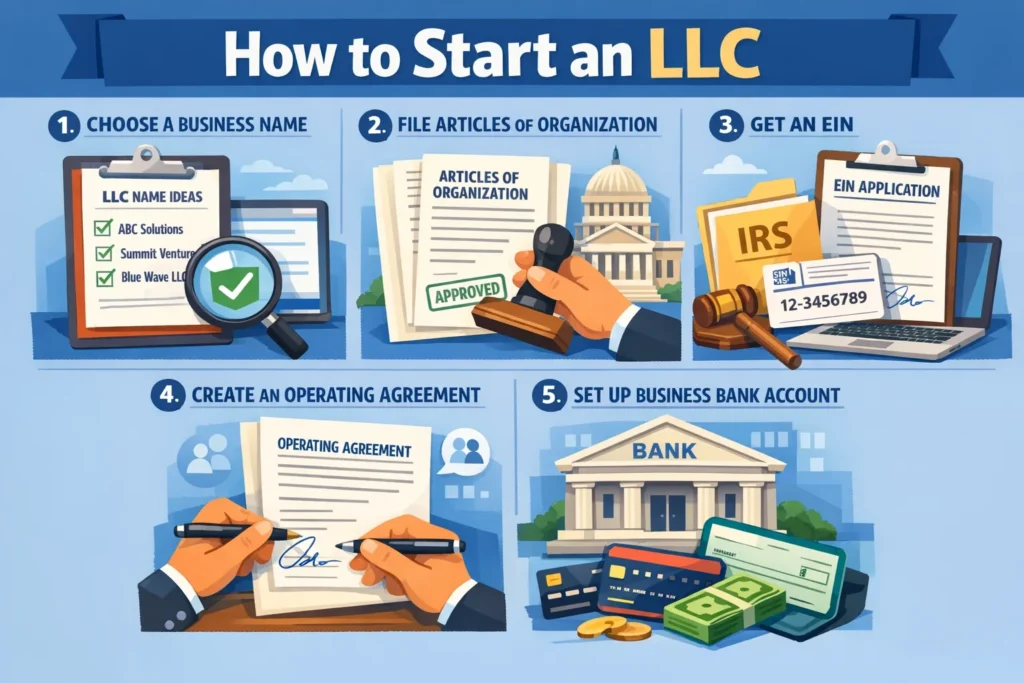
Forming an LLC in Texas involves a few simple steps. Most business owners can complete the process in a single afternoon if they have their information ready.
1. Search Your LLC Name
The first step in forming an LLC is choosing a business name that is unique and available in Texas.
Your company name will appear on official documents, contracts, and branding materials, so it is worth taking time to pick something clear and memorable.
LLC Name Requirements in Texas:
Texas law requires LLC names to follow certain rules.
- The name must include “Limited Liability Company,” “LLC,” or “L.L.C.”
- It must be different from other registered businesses in Texas
- It cannot contain words that could confuse the business with a government agency
- Certain restricted words may require special approval
Choosing a clear and professional name helps build credibility with customers and partners.
2. Choose a Registered Agent
Every LLC in Texas must appoint a registered agent. This person or company receives legal documents and official government correspondence on behalf of your business.
For example, if your company is sued or receives state notifications, the registered agent receives those documents.
Who Can Be a Registered Agent?
In Texas, a registered agent can be:
- An individual who lives in Texas
- A Texas resident who is at least 18 years old
- A company authorized to provide registered agent services in Texas
The registered agent must also have a physical address in Texas, known as the registered office.
A P.O. box cannot be used.
3. File a Certificate of Formation
The Certificate of Formation is the official document that creates your LLC in Texas.
Once this form is filed and approved by the Texas Secretary of State, your business legally exists.
Information Required to File the Certificate of Formation:
You will need to provide several pieces of information when filing the form.
These typically include:
- Your LLC name
- Registered agent name and address
- Business address
- Names of LLC members or managers
- Management structure of the LLC
- Purpose of the business
Most LLCs choose a general purpose such as engaging in lawful business activities.
4. Create an Operating Agreement
An operating agreement is a document that outlines how your LLC will be managed.
Texas does not legally require LLCs to create one, but it is strongly recommended.
This document helps prevent misunderstandings between members and establishes clear rules for the business.
5. Get an EIN for Your LLC
An EIN, or Employer Identification Number, is issued by the Internal Revenue Service.
It functions like a Social Security number for your business.
Most LLCs need an EIN to handle taxes, hire employees, and open business bank accounts.
How to Apply for an EIN:
Applying for an EIN is simple and free.
You will need to provide basic details about your business such as:
- LLC name
- Business address
- Responsible party information
- Number of employees expected
Once approved, you receive your EIN immediately if you apply online.
Why Do You Need an EIN?
An EIN is required for many essential business activities.
You typically need it to:
- Open a business bank account
- Hire employees
- File federal taxes
- Apply for business licenses
Even single member LLCs without employees often obtain an EIN to separate personal and business finances.
Top LLC Formation Services in Texas
While it is possible to file your LLC paperwork yourself, many business owners use formation services to save time and avoid mistakes.
These companies handle the paperwork, check for errors, and guide you through the process.
Below are some of the most popular LLC services entrepreneurs use.
1. Northwest Registered Agent

Northwest Registered Agent is widely respected for its privacy protection and customer support. Unlike many competitors, the company focuses on straightforward pricing without heavy upselling.
Key benefits include:
• Excellent customer support from knowledgeable staff
• Strong privacy protection for business owners
• Free registered agent service for the first year with formation packages
• Transparent pricing structure
• Fast document processing
Many entrepreneurs appreciate the company’s focus on helping business owners understand the formation process rather than pushing unnecessary add ons.
2. ZenBusiness

ZenBusiness has quickly become one of the most popular LLC formation services for small businesses and startups.
Its platform is designed to be beginner friendly, and the company offers affordable pricing tiers for different needs.
Popular features include:
• Affordable starter packages
• Compliance monitoring tools
• Operating agreement templates
• Business website and domain options
• Ongoing customer support
ZenBusiness is often recommended for entrepreneurs who want an easy to use service with a wide range of additional business tools.
3. LegalZoom

LegalZoom is one of the most recognizable names in the online legal services industry. The company has helped millions of entrepreneurs start businesses and handle legal paperwork.
Advantages include:
• Strong brand reputation
• Large library of legal resources
• Access to legal professionals
• Multiple business formation services
• Well established customer support system
Although LegalZoom is typically more expensive than other services, many entrepreneurs choose it because of its experience and reputation.
4. Bizee (formerly Incfile)

Bizee, previously known as Incfile, is known for offering affordable LLC formation packages. The company has helped form hundreds of thousands of businesses across the United States.
Key features include:
• Free LLC formation package (state fee not included)
• Free registered agent service for the first year
• Easy to use online dashboard
• Lifetime company alerts for compliance reminders
• Fast processing times
For budget conscious entrepreneurs, Bizee remains one of the most attractive options available.
5. Tailor Brands

Tailor Brands is slightly different from traditional LLC formation companies because it combines business formation with branding tools.
Entrepreneurs can create logos, build websites, and develop brand assets alongside their LLC formation.
Popular features include:
• Logo design tools
• Website building platform
• Brand identity services
• LLC formation packages
• Social media branding tools
This service is often appealing for new entrepreneurs who want both business formation and branding support in one place.
Each of these services has its own strengths, and users often compare features like pricing, turnaround time, customer service, and extras like compliance alerts or document storage.
What Do I Do After My LLC Is Approved?
Once your Certificate of Formation is approved, your LLC officially exists. However, there are still several important tasks to complete.
These steps help ensure your business remains compliant and financially organized.
Some common next steps include:
- Opening a business bank account
- Obtaining business licenses or permits
- Setting up accounting systems
- Filing required tax reports
Texas LLCs also have ongoing filing requirements that business owners must understand.
How Much Do the Franchise Tax Return and Public Information Report Cost?
Texas requires most LLCs to file two annual reports:
- Franchise Tax Report
- Public Information Report (PIR)
For many small businesses, the franchise tax owed is zero because Texas provides a no tax due threshold.
If your business earns less than the threshold amount, you will not owe franchise tax but still must file the report.
The Public Information Report also has no separate filing fee.
How Do I File My LLC Franchise Tax and Public Information Report?
Texas allows businesses to file these reports online through the state’s tax system.
During the filing process, you will provide information such as:
- Revenue for the business
- Business address
- Ownership details
- Contact information
Most small businesses can complete the filing in less than 20 minutes.
How Will My LLC Be Taxed?
One of the advantages of an LLC is flexible taxation.
By default, the IRS treats LLCs as pass through entities.
This means the business itself does not pay federal income tax. Instead, profits and losses pass through to the owners’ personal tax returns.
Single member LLCs are typically taxed as sole proprietorships, while multi member LLCs are taxed as partnerships.
However, LLCs can also choose to be taxed as an S corporation or C corporation if it benefits their financial situation.
Many growing businesses elect S corporation taxation to reduce self employment taxes.
A tax professional can help determine the best option for your situation.
Conclusion
Starting an LLC in Texas is a straightforward process that offers strong benefits for entrepreneurs.
With liability protection, flexible taxation, and a simple formation process, an LLC is often the best choice for small business owners.
The key steps include choosing a business name, appointing a registered agent, filing the Certificate of Formation, creating an operating agreement, and obtaining an EIN.
Once your LLC is approved, remember to stay compliant by filing your annual franchise tax reports and maintaining proper business records.
With the right preparation, forming an LLC in Texas can be completed quickly, allowing you to focus on growing your business.
FAQs
ow long does it take to form an LLC in Texas?
If you file online, approval usually takes about 3 to 7 business days. Mailed applications can take a few weeks depending on the processing time at the Texas Secretary of State.
Can I start an LLC in Texas by myself?
Yes. Texas allows single member LLCs. This means one person can own and operate the business without needing partners.
Do I need a business license for my Texas LLC?
Texas does not require a general statewide business license. However, some industries such as construction, food services, or healthcare may require permits or professional licenses.
Can I be my own registered agent in Texas?
Yes, you can serve as your own registered agent as long as you are a Texas resident with a physical address in the state and are available during normal business hours to receive legal documents.
Do Texas LLCs pay state income tax?
Texas does not have a state personal income tax. However, LLCs may need to file an annual franchise tax report depending on the business’s revenue.
Do I need an operating agreement for a Texas LLC?
Texas does not legally require an operating agreement, but it is strongly recommended. It helps define ownership, responsibilities, and how decisions will be made within the company.